

The alarm bells blast throughout stations at 3:00 am. Within a matter of minutes, you’re carrying sixty pounds of gear, walking up a narrow staircase, and ready to carry a pressurized hose line across a smoke-filled hallway. In this industry, it’s not only about looking great while wearing a uniform, but it is also the very lifeline for your entire team and the people you pledged to defend.
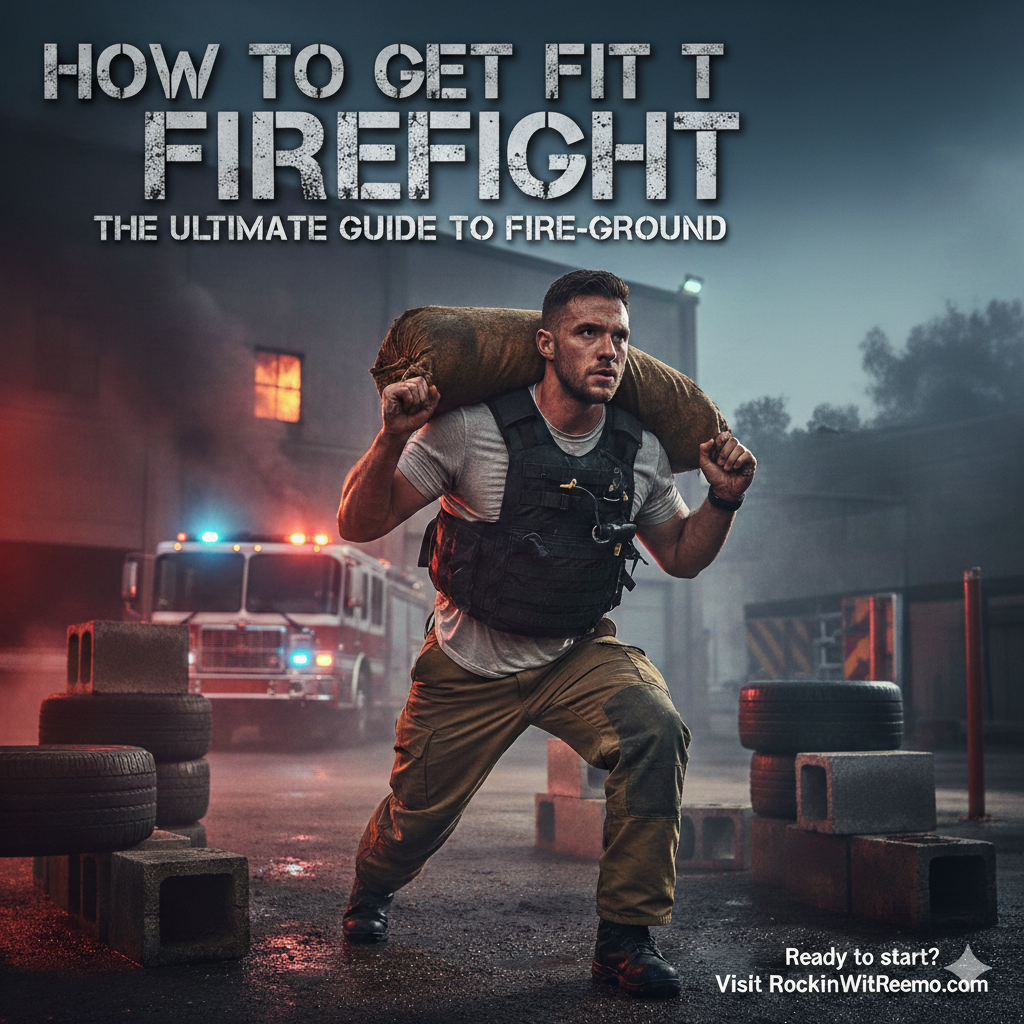
If you’re thinking about what you need to do to be fit enough to become an emergency responder, you’ve probably discovered that a simple “bodybuilding” exercise routine or a routine run around the block isn’t going to suffice. Firefighting requires a specific blend of explosive power, endurance through anaerobic exercise, and mental toughness. We at Rockin Wit Reemo are experts at turning candidates into tactical athletes. You may be getting ready for your CPAT (Candidate Physical Ability Test) or trying to get through the tough times of the Fire Academy. This guide will provide the key elements of fitness for firefighters.
1. Understand the “Tactical Athlete” Mindset
Before you pick up an exercise weight, it is important to modify your perspective on the exercise. Firefighters are athletes who can be considered tactical, in contrast to a marathon runner who knows precisely when the race will begin or a powerlifter who can rest for a few minutes between sets. Firefighters have to be prepared to work at full intensity without warning.
If you are researching ways to be fit to become an emergency responder, the first step is to focus on “functional” actions before “isolated” ones. Bicep curls may look good, but they’re not going to assist you in hoisting a 24′ extension ladder. You require movements that replicate the work of pulling, pushing, carrying, and climbing.
2. Master the “Big Four” Compound Lifts
To build the strength needed to lift the heavy machinery, your training program must be anchored with compound lifts. These exercises work multiple muscles and joints simultaneously.
Deadlifts are essential for building the “posterior chain” (lower back, glutes, hamstrings). This is the source of power for dragging the victim and lifting heavy equipment.
Front Squats. They are akin to the upright posture required when carrying heavy saws.
Overhead Press is essential for shoulder stability and strength when climbing over ceilings or lifting ladders.
Weighted Lunges: Firefighting is not often performed with two feet on the ground. Lunges help build the leg strength needed to climb stairs and navigate through debris.
Grip strength is also critical, especially during forcible entry evolutions where maintaining control of tools is essential.
3. Developing Metabolic Conditioning (The “Gas Tank”)
It isn’t worth the effort if you can’t breathe after just five minutes. One of the most difficult hurdles in understanding how to train to become an emergency responder is regulating your “VO2 Max” while wearing an air-tight self-contained breathing apparatus (SCBA).
At Rockin Wit Reemo, we focus on the importance of High-Intensity Interval Training (HIIT). Instead of lengthy, slow workouts, consider “EMOM” (Every Minute On the Minute) exercises. Examples:
Minute 1: 15 Kettlebell Swings
Minute 2: 10 Burpees
Minute 3: 100-foot Sandbag Carry
Repeat for 20 minutes.
This type of training helps the body learn to eliminate lactic acid and recover quickly. It’s exactly what occurs in between “rounds” at the fireground.
4. The Importance of Core Stability
The “core” isn’t only your six-pack. It’s also the bridge that connects your lower and upper body. If you’re slogging through the dark of a room or using a nozzle, your core protects your spine from injury.
Do not do the standard crunches. Instead, concentrate on anti-rotational exercises such as the Pallof Press as well as weighted carries such as those used in the Farmer’s Walk. Incorporating heavy dumbbells into each hand while standing up straight is among the most efficient ways to train to become an emergency responder, as it increases total-body tension.
5. Don’t Forget the “Fire Academy Prep” Specifics
If you are looking to pass the college, you need to prepare for the particular examinations you’ll be taking. The CPAT test is an accelerated exercise that includes stair climbing with a vest weighing 75 pounds, a hose drag, and the model rescue.
Pro Tips: Start wearing a weighted vest for your workouts. Training with 20-50 pounds on your body alters your center of gravity and significantly increases your heart rate. In our Rockin Wit Reemo, we frequently tell our clients: “Don’t let the first time you put on an outfit be the day you take your test.”
6. Recovery: The Unsung Hero of Firefighter Fitness
It’s not like you get stronger in the gym, but you become stronger as you rest. Firefighters are often sleep-deprived and stressed, which can increase cortisol levels. To understand how to become fit enough to become an effective firefighter and be a good one, you need to respect the process of recovery.
Mobility Exercise: Use foam rollers and dynamic stretching to keep joints flexible. Firefighters are at increased risk of lower back and hip problems. Mobility will help you stay healthy.
Diet: Fuel your body with quality proteins and complex carbs. You’re an engine. Make sure you don’t use low-quality fuel in a high-performance machine.
7. Mental Toughness: The “Why” Behind the Sweat
There will be a moment during your training–and also on the field of fire–when your muscles are ready to stop. This is when mental conditioning comes into play. One of the most important aspects of figuring out how to stay fit enough to become an emergency responder is to put yourself in difficult situations during your training.
If it’s just one more set of stairs after your legs are aching or completing your workout when it’s raining, these tiny “wins” can help build the determination needed to stay in control when something goes wrong during a structure fire.
8. Why Professional Coaching Matters
There are many workout programs online; however, firefighting is too risky a job for you to “DIY” your preparation. A specific program, such as those offered by The Rockin Wit Reemo, provides accountability and knowledge.
We don’t simply give you an exercise list. We also provide a plan. We understand the specific requirements of the FDNY and other departments. If you follow a well-planned strategy to become fit for the firefighter role, you can eliminate any doubts and reduce the risk of injury during the pre-academy phase.
9. Consistency Over Intensity
A common error is working “too intensely” for two weeks, then exhausting oneself. The fitness of firefighters is comparable to that of a marathon runner, not an endurance racer. It is more beneficial to train moderately four days a week for a year than to train every day for a month and get injured. Develop a habit of showing up. Fire service operations are based on trust. Your fitness should be as well.
10. Taking the First Step
Now that you’ve got the steps for getting ready to become a firefighter, it’s time to act. Start by taking a look at your current health. Are you able to climb three steps without breathing? Are you able to lift half of the weight of your own body?
Don’t let yourself be discouraged if you don’t feel “Fire ground ready” as of yet. Every firefighter of the past was exactly where you were at the beginning.
Summary: Your Adventure through Rockin Wit Reemo
We are the Rockin Revolution. We are committed to helping the future Generation of Heroes. Our philosophy of training is straightforward: we are trained to be firefighters, not for the mirror. If you’re interested in learning how to become an emergency responder, we’d like to welcome you to our firefighter community.
With our specially designed applications, remote fitness coaching through our app (available on Apple and Google Play), group fitness sessions, and 1-on-1 coaching, we give you the tools you need to successfully pass the CPAT and excel during your time at the Fire Academy. The fireground can be an extremely challenging environment; however, with the proper practice, you’ll be able to walk onto the field with confidence.
Are you ready to begin? Go to RockinWitReemo.com today to learn more about our training programs and get started. Your future team is dependent on you.
Boost your performance with our firefighter training program built for real-world demands. Our firefighter workout program includes firefighter strength training and proven firefighter CPAT workout routines.
Read more about: What is a Fit Test for Firefighters?
Frequently Asked Questions
1. How do I get started?
Start with basics—strength, conditioning, and movement. Build from there.
2. What level of fitness is needed?
High enough to handle repeated physical effort under load.
3. What exercises should I focus on?
Deadlifts, stairs, carries, lunges, and conditioning circuits.
4. How long does it take?
8–12 weeks for a solid base, longer for peak performance.
5. Why is functional training important?
Because the job isn’t done on machines—it’s done in real-world conditions.