
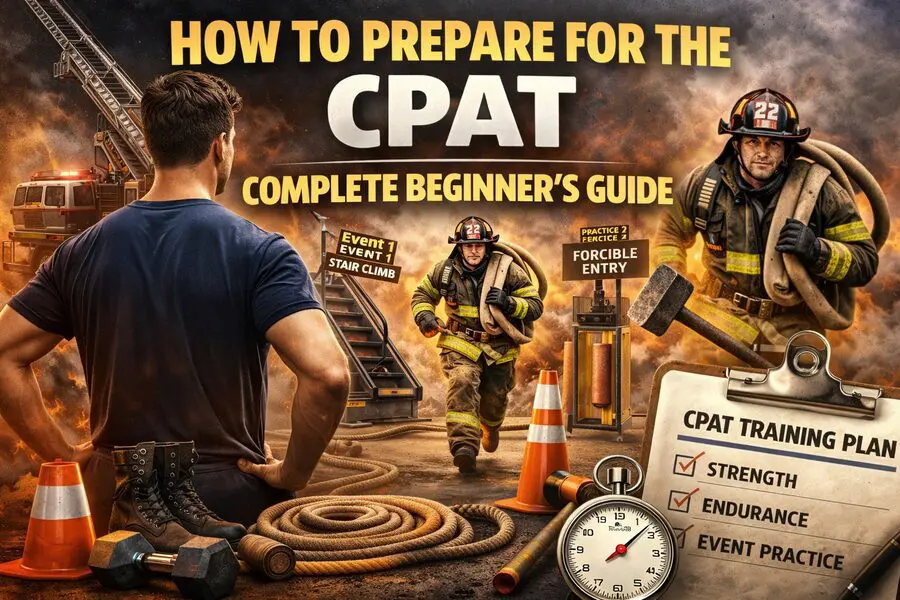
If you’re serious about becoming a firefighter, then passing the CPAT (Candidate Physical Ability Test) is non-negotiable. It’s not just a fitness test—it’s a real-world simulation of the physical demands firefighters face every day. Many beginners underestimate it, and that’s exactly where they fail.
The good news? With the right strategy, consistency, and mindset, you can absolutely pass it—even if you’re starting from scratch.
In this complete beginner’s guide, I’ll walk you through exactly how to prepare for the CPAT, what to expect, and how to train smart—not just hard.
What Is the CPAT and Why Does It Matter
The CPAT is a standardized physical test used across North America to assess whether candidates are physically capable of performing essential firefighting tasks.
It includes 8 events, all done continuously while wearing a 50-pound weighted vest. You have 10 minutes and 20 seconds to complete everything.
CPAT Events Include:
- Stair climb
- Hose drag
- Equipment carry
- Ladder raise and extension
- Forcible entry
- Search
- Rescue drag
- Ceiling breach and pull
Each event simulates real emergencies. This means your training must also be functional—not just gym-based.
Step 1: Understand the Physical Demands
Before jumping into training, you need to understand what your body will go through.
The CPAT tests:
- Cardiovascular endurance
- Muscular strength
- Muscular endurance
- Grip strength
- Core stability
Beginner mistake: Only focusing on running or lifting weights.
Reality: You need a balanced approach. Firefighter fitness is about performance under fatigue.
Step 2: Build a Strong Fitness Foundation
If you’re new, don’t try to train like an advanced athlete from day one.
Focus on These 4 Areas:
1. Cardio Endurance
You’ll be constantly moving under load. Start with:
- Brisk walking → Jogging → Running
- Stair climbing (very important)
- Incline treadmill workouts
Goal: 20–30 minutes of steady cardio without stopping.
2. Strength Training
Focus on compound movements:
- Deadlifts
- Squats
- Lunges
- Shoulder press
- Rows
These mimic real firefighting tasks like lifting, dragging, and pushing.
3. Functional Training
This is where most candidates fail.
Add exercises like:
- Farmer’s carries (for equipment carry)
- Sled push/pull (for hose drag simulation)
- Tire hits (for forcible entry)
- Sandbag carries (for rescue drag)
4. Grip Strength
Grip failure is one of the top reasons people don’t pass.
Train with:
- Dead hangs
- Farmer’s carries
- Plate pinches
Step 3: Train Like the CPAT
One of the biggest mistakes beginners make is training randomly.
You should replicate CPAT conditions as closely as possible.
Sample CPAT Circuit Training:
- Stair climb (5 minutes)
- Farmer’s carry (heavy weights)
- Sled drag or resistance band pull
- Ladder simulation (shoulder press or rope pulls)
- Tire strikes or sledgehammer work
- Crawl (for search simulation)
- Sandbag drag
Do this without long rest periods.
Why? Because the CPAT is continuous. You don’t get breaks.
Step 4: Improve Stamina Under Fatigue
Passing the CPAT is not about being fresh—it’s about performing when exhausted.
Try This:
- Combine cardio + strength in one session
- Example:
- 10 min stair climb
- Immediately enter the strength circuit
- Minimal rest
This trains your body to keep going even when tired.
Step 5: Focus on Technique (Not Just Strength)
Many candidates are strong but still fail.
Why? Poor technique.
Examples:
- Using legs instead of the back for lifting
- Efficient breathing during stair climbing
- Proper body positioning during hose drag
Tip: Watch CPAT demonstration videos and practice movements.
Step 6: Create a Weekly Training Plan
Consistency beats intensity.
Beginner Weekly Plan:
Day 1: Strength + Grip
Day 2: Cardio + Stairs
Day 3: Functional Training
Day 4: Rest or Light Activity
Day 5: CPAT Circuit Training
Day 6: Cardio Endurance
Day 7: Rest
Step 7: Nutrition and Recovery Matter More Than You Think
You can’t out-train a bad diet.
Focus on:
- High protein (muscle recovery)
- Complex carbs (energy)
- Hydration (performance)
Recovery Tips:
- Sleep at least 7–8 hours
- Stretch regularly
- Avoid overtraining
Step 8: Practice with Weighted Gear
The CPAT requires you to wear a weighted vest.
If you don’t train with weight, the test will feel 10x harder.
Start with:
- Light vest (10–20 lbs)
- Gradually increase weight
This builds:
- Strength under load
- Mental toughness
Step 9: Mental Preparation Is Key
The CPAT is as much mental as it is physical.
At some point, your body will want to quit.
Train Your Mind:
- Push through discomfort
- Stay calm under pressure
- Focus on one task at a time
Pro tip: Don’t think about the whole test—just the next step.
Step 10: Avoid Common Beginner Mistakes
Here’s what most beginners get wrong:
Only doing gym workouts
Ignoring stair training
Not practicing CPAT simulations
Skipping recovery
Training without a plan
Fix these early, and you’ll already be ahead of 80% of candidates.
How Rockin Wit Reemo Can Help You
At Rockin Wit Reemo, we don’t just train you—we prepare you for the real demands of firefighting.
Our firefighter fitness programs are designed specifically for:
- CPAT preparation
- Fire academy readiness
- Real-world performance
We focus on:
- Functional strength
- Endurance under pressure
- Task-specific training
So you don’t just pass—you dominate.
Final Thoughts
Preparing for the CPAT as a beginner may feel overwhelming, but it’s completely achievable with the right approach.
Remember:
- Train smart, not just hard
- Focus on real-world movements
- Stay consistent
The CPAT is your first step toward becoming a firefighter. Treat it seriously, and give it everything you’ve got.
Read more about: Best Firefighter Workout Plan to Build Strength and Endurance
Frequently Asked Questions
1. What is the CPAT test?
The CPAT is a timed physical test that puts you through 8 job-specific tasks under load. It’s not a workout—it’s a pass-or-fail simulation of the job.
2. How long does it take to prepare for CPAT?
For most beginners, 8–12 weeks is realistic. Less than that, and you’re rushing it.
3. What is the CPAT time limit?
You get 10 minutes and 20 seconds. No pauses, no resets—just continuous work.
4. What should I train to pass CPAT?
Stairs, carries, drags, and full-body conditioning. If you’re not training under fatigue, you’re not training for CPAT.5. Is CPAT hard for beginners?
Yes—but it’s completely passable if you train properly and give yourself enough time.