
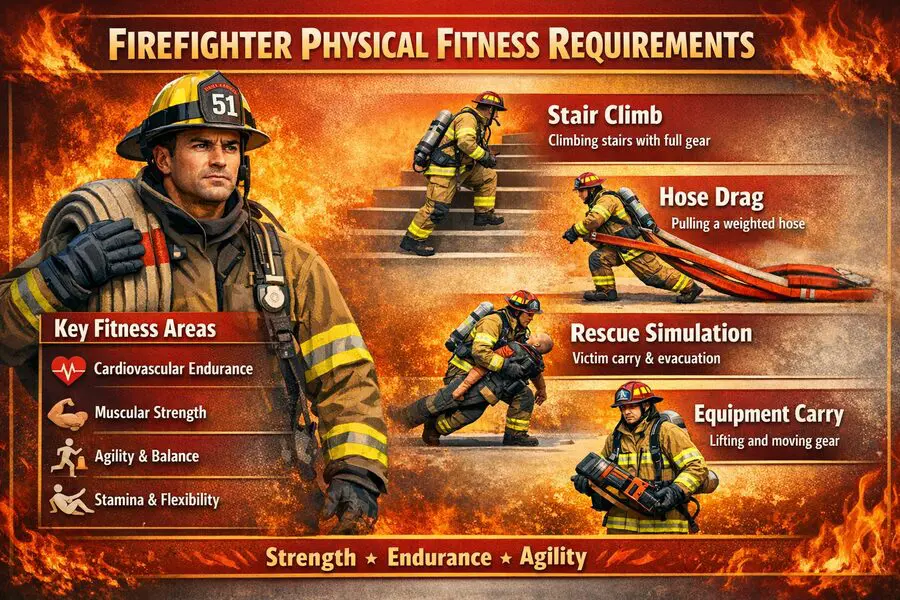
Becoming a firefighter is about much more than courage and commitment. It demands exceptional physical conditioning, endurance, and mental resilience. Every call, whether it’s a building fire, rescue operation, or emergency response, requires firefighters to perform physically demanding tasks under intense pressure. That’s why firefighter physical fitness requirements are strict and carefully designed to ensure candidates are capable of handling the realities of the job.
At Rockin Wit Reemo, firefighter fitness is taken seriously. Training programs are designed to help candidates prepare for the demands of the fire academy, CPAT testing, and real-world fireground challenges. Instead of generic workouts, firefighter-focused training builds the strength, stamina, and functional power needed to succeed in this demanding profession.
In this guide, we’ll break down the firefighter physical fitness requirements, what tests you may face, and how to train effectively so you can meet—and exceed—the standards.
Why Physical Fitness Is Critical for Firefighters
Firefighters operate in environments that most people would find overwhelming. They often carry heavy gear, climb stairs in burning buildings, drag victims to safety, and operate tools under extreme heat and stress.
A firefighter’s gear alone can weigh 70–75 pounds, not including tools and equipment. On top of that, firefighters may need to:
- Climb multiple flights of stairs
- Drag heavy hoses
- Carry victims weighing over 150 pounds
- Break through doors and walls
- Navigate dark and hazardous environments
Because of these demands, firefighter physical fitness requirements are designed to ensure candidates have the strength, endurance, and agility to perform these tasks safely.
Without proper conditioning, the risk of injury increases dramatically. Strong physical preparation not only helps firefighters pass entrance exams but also supports long-term health throughout their careers.
Core Components of Firefighter Physical Fitness Requirements
Most fire departments and academies evaluate candidates through structured physical ability tests. These tests simulate real-life firefighting scenarios and measure overall functional fitness.
1. Cardiovascular Endurance
Firefighting is often described as a series of high-intensity bursts followed by short recovery periods. Strong cardiovascular endurance ensures firefighters can perform physically demanding tasks without exhausting themselves too quickly.
Typical endurance requirements include:
- Stair climbing with weighted vests
- Running or high-intensity interval training
- Sustained physical activity under load
Cardio training helps maintain oxygen efficiency, which becomes critical during emergency situations.
2. Functional Strength
Traditional bodybuilding exercises alone won’t prepare you for firefighting. Instead, firefighters need functional strength that transfers directly to job tasks.
Key strength requirements include:
- Lifting heavy equipment
- Dragging hoses or victims
- Carrying tools over a distance
- Pushing and pulling heavy loads
Functional movements such as deadlifts, squats, and sled pushes build the posterior chain muscles used during real fireground activities. According to Rockin Wit Reemo’s training methods, compound exercises are the foundation of firefighter performance training.
3. Muscular Endurance
Muscular endurance allows firefighters to sustain repeated movements without fatigue. Unlike traditional gym workouts, firefighting requires continuous effort while wearing heavy gear.
Muscular endurance training includes:
- High-repetition functional exercises
- Circuit training
- Weighted stair climbs
- Carry drills
Improving muscular endurance helps firefighters maintain performance during long rescue operations.
4. Grip Strength
Grip strength is one of the most overlooked firefighter physical fitness requirements, yet it’s essential for handling tools and equipment.
Firefighters constantly grip and control objects such as:
- Hose lines
- Axes
- Saws
- Ladders
Exercises like farmer’s carries, rope pulls, and dead hangs are commonly used to develop the grip strength required for firefighting tasks.
5. Core Stability
A strong core protects firefighters from injury and allows them to stabilize heavy loads while moving through challenging environments.
Core stability is crucial for:
- Carrying heavy gear
- Maintaining balance on ladders
- Dragging victims
- Preventing back injuries
Effective core exercises include planks, rotational lifts, sandbag carries, and anti-rotation drills.
The CPAT: The Standard Firefighter Fitness Test
One of the most widely used tests to measure firefighter physical fitness requirements is the Candidate Physical Ability Test (CPAT). This standardized test simulates the physical demands of firefighting through eight sequential events.
Common CPAT events include:
Stair Climb
Candidates climb a stair machine for over three minutes while wearing a 75-pound vest to simulate firefighting gear.
Hose Drag
Participants drag a charged fire hose over a distance and then pull additional hose into a designated area.
Equipment Carry
Candidates carry heavy tools such as power saws over a set distance.
Ladder Raise and Extension
This event measures upper-body strength by requiring candidates to lift and extend a ladder.
Forcible Entry
Participants use a weighted sledgehammer to simulate breaking through doors or walls.
Search
Candidates navigate through a dark, confined space filled with obstacles.
Rescue Drag
A mannequin weighing approximately 165 pounds must be dragged across a set distance.
Ceiling Breach and Pull
This test simulates breaking through ceilings during fire suppression.
These tasks must be completed within a strict time limit, typically around 10 minutes and 20 seconds.
How to Train for Firefighter Physical Fitness Requirements
Preparing for firefighter fitness standards requires more than a traditional gym routine. Training should mimic the real movements firefighters perform on the job.
Train With Functional Circuits
Circuit training builds both strength and endurance simultaneously. A typical firefighter circuit might include:
- Sled drags
- Weighted stair climbs
- Farmer’s carries
- Sandbag lifts
- Burpees or kettlebell swings
These exercises simulate the “work-rest” pattern of firefighting emergencies.
Incorporate Weighted Training
Many firefighter tests require wearing weighted gear. Training with weighted vests helps your body adapt to the load you’ll experience during real scenarios.
Start light and gradually increase weight to avoid injury.
Focus on Posterior Chain Strength
Your hamstrings, glutes, and lower back form the posterior chain—one of the most important muscle groups for firefighters.
Exercises to strengthen this area include:
- Deadlifts
- Kettlebell swings
- Lunges
- Step-ups
These movements replicate lifting, dragging, and climbing tasks common in firefighting.
Improve High-Intensity Conditioning
High-intensity interval training (HIIT) prepares your body for the stop-and-go intensity of firefighting.
Examples include:
- Sprint intervals
- Stair sprints
- Battle rope circuits
- EMOM (Every Minute on the Minute) workouts
These workouts train your body to recover quickly between bursts of activity.
Common Mistakes Candidates Make
Many aspiring firefighters underestimate the complexity of the physical fitness requirements for firefighters.
Common mistakes include:
Training like a bodybuilder
Isolated exercises don’t prepare you for functional tasks like hose drags or ladder raises.
Ignoring endurance
Strength is important, but firefighters also need cardiovascular capacity.
Neglecting grip strength
Many candidates fail equipment events due to weak forearms.
Skipping recovery and mobility
Mobility work reduces injury risk and improves overall performance.
Building Long-Term Firefighter Fitness
Passing the entrance exam is only the beginning. Firefighters must maintain their fitness throughout their careers.
Rockin Wit Reemo’s training programs focus on developing long-term durability, injury prevention, and real-world performance—not just test preparation. Their programs combine strength training, conditioning, mobility, and structured coaching to help firefighters stay fire-ready year-round.
Consistency is key. Training with purpose and focusing on functional movement patterns will prepare you not only to pass the test but to excel in the field.
Final Thoughts
The firefighter’s physical fitness requirements are designed to prepare candidates for one of the most physically demanding professions in the world. Strength, endurance, agility, and mental toughness all play a role in becoming a successful firefighter.
By training with a firefighter-specific approach—focusing on functional strength, cardiovascular endurance, and realistic task simulation—you can dramatically improve your readiness for the academy and beyond.
If you’re serious about entering the fire service, start training like a firefighter today. With the right preparation, discipline, and structured guidance, you can build the strength and resilience required to protect lives and serve your community.
Boost your performance with our firefighter training program built for real-world demands. Our firefighter workout program includes firefighter strength training and proven firefighter CPAT workout routines.
Read more about: How to Get Fit to Be a Firefighter: The Ultimate Guide to Fire-Ground Readiness
Frequently Asked Questions
1. What fitness level is required?
You need strength, endurance, and the ability to perform under load—consistently.
2. What is the CPAT in this context?
It’s the baseline test that proves you can handle the job physically.
3. How fit should I be?
Fit enough that physical work doesn’t slow you down.
4. How should I train?
Functional strength + conditioning + job-specific movements.
5. Biggest mistake candidates make?
Training like it’s a gym goal instead of a job requirement.